|
|
What is this Lightweight Backpacking all about?
Well the simple answer, is to make your trip easier and more enjoyable. Virtually anywhere in the UK, all ages can been seen at any time of year carrying a backpacking load and heroically climbing mountains, roaming hills or crossing fields. Everyone from day walkers, right through to young DofE (Duke of Edinburgh participants) and long distance hikers get out to enjoy their surroundings. The weight of the items they carry directly effect their enjoyment. The heavier it is, the more miserable they are. The lightweight phylosphy came about when we started questioning our sanity in carrying over engineered products sold to us by marketing departments. By reverting back to the KISS principle (keep it simple stupid!) weight was reduced and enjoyment increased. Why make it harder than you ‘need’ it to be?
Surely you need lots of stuff to enjoy it?
We’ve lost count of the number of people we have spoken to, who remember their first outdoor or DofE experience at a young tender age as being one of intense misery and pain, due the shock and agony of carrying their first rucksack loaded to the hilt. Many older ‘born again’ hikers now come to us at the other end of the age scale knowing they can no longer carry 20kg+ loads and seek reassurance that this ‘new’ philosophy will still provide them with comfort and enjoyment.
Symptoms of carrying too much weight include; exhaustion, irritability, low team spirit, increased chance of injury, chafing, sore body parts, back, knees, tendons, muscles, blisters, shoulders, twisted ankles, a tedious view of the trip, dehydration, loss of heat through sweating.
Of course when you are tired any decision you make can be a poor, even dangerous, one. Finally, exhaustion means you just don’t enjoy the main reason you are there. The chilling out, chatting, sunbathing, camp cooking, counting the stars, exploring your surroundings and a good nights sleep in the fresh open air.
Somewhere in mix we also find other outdoor lightweight enthusiasts, cyclists, kayakers and world travellers who also are beginning to hear and understand that lighter is better. Literally the message is getting out there, ‘minimum weight – does really equal maximum fun!’
What is classed as lightweight?
The universally accepted weighing method to calculate your ‘base weight’, is to place all the contents for your trip into your rucksack minus food, water and any items you will be wearing
The Roman Legionary carried the same load on his back as a modern soldier today. 35kg/80lbs (inc food and water) being the maximum amount a man can carry and still function in the mud. (This is serious hard core!)
Traditional hiking packs weights are typically found to be around 30 pounds/14kg plus. (This is where the misery begins)
Lightweight is classed as below 20 Pounds/9.1kg. (Anything below 10kg is easy)
Ultralight is below 10 Pounds/4.5kg. (You are now able to run with the pack)
Super-Ultralight is below 5 Pounds/2.3kg. (You can almost forget its there!)
(You’ll notice the American influence here, as they do like their round numbers, however we will be referring to Kg generally in this piece.)
|
|
|
|
|
|
|
|
|
First things first, health and safety
We are told by various health and posture experts, that we should carry no more than 20% of our body weight to prevent long term damage to our frame and joints. For example a 13st male should carry a maximum of 30 Pounds or 14kg, and a 9st Female no more than 16 Pounds or 6.5Kg.
This is a good starting point and will give you a general target to start aiming for. Just because you are young and fit and ‘can’ carry the weight’ doesn’t mean you ‘will’ enjoy it more. Sadly it is true to say that the pain and damage in your joints will potentially last longer in your future years, than the lingering memory of the views.
Secondly, the journey to using lightweight equipment is one we always suggest people take time to undertake. If you are used to carrying big loads, with lots of ‘just in case’ equipment and luxuries, the sudden leap to any of the lightweight categories can be a bit of a shock and you should never place yourself in danger in extreme conditions, until you have knowledge and faith in yourself and your lightweight gear.
Okay so where do I start?
Usually with a slight altering of your normal approach and another look at your equipment (or list) with fresh eyes. The general idea is to look at the four key areas where weight creeps up and to also consider alternative uses for as many items as possible. (This will unfold as we go along).
The Shelter System
If you have been used to a large comfortable tent (3kg+), we are not going to suggest an immediate drastic change to a micro tarp. It would be too much of a comfort shock. However lets look at the system you use and ask some questions. For a solo hiker there are now 2 skin tents available weighing between 1kg and 1.5kg. However anything sub 2kg is ideal. With your tent do you normally take a pile of extra pegs (just in case), a ground sheet protector, all of the guy lines and the original bag it was supplied in? Why not weigh those separate items and see what they add up to (1kg+)? Then consider exchanging them for lighter alternatives, such as Titanium Pegs, Dyneema Cord, Mini Line Locks and an Ultralite Bag. Do you really also need that ground sheet protector?
If you go to the next stage and consider a tarp supported by walking poles, a whole new world opens up to you at minimum weight. All of a sudden you can have a large shelter system for under a kilo. (Without a groundsheet or bug netting). In fact the 2010 Shangri-La 3 tent will provide you with an enclosed space for 3 people at only 800g (excluding groundsheet). Doesn’t that old tent suddenly start to sound heavy by comparison? (Saving 3kg+)
The Sleep System
The tendency we have is to assume that to be as ‘snug as a bug’ we need a nice thick warm sleeping bag, a thick full length sleeping mat and a big a fluffy pillow (4kg+). This is certainly ideal for a warm comfortable nights sleep, however during the day you are of course carrying all these items and not using them for anything else. Does that make sense? When you lie down, do you actually fill a 6 foot mat?
How about considering a ‘short’ (torso length) inflatable mat, or cutting down a foam one with a pair of scissors cut from your shoulders to just below your bum (170g)? Then use your roll top waterproof sack, which the sleeping bag was transported in, as your pillow, placing your day clothes inside. To prevent your feet chilling against the ground, slide the rucksack under your feet. A lighter down sleeping bag (800g), can be supplemented with a layer or two of fleece or a down jacket (250g). Wear your dry tent socks and fleece hat in bed (all of them if you are cold), and you will be very warm. Of course all the other items are also worn during the day, and it is only the sleeping bag which provides extra when needed. (Saving 2kg+)
|
|
|
|
The Cook System
Gear is great fun, and cooking equipment especially so. The appeal of shiny new kit, with lots of pots, pans, mugs, cutlery, spice boxes, folding plates, and stoves made from Titanium and other exotic materials, is an endless source of discussion and fascination, as you drool over what you think you might cook in the wilds (2kg+). However rather than take it all (just in case you want to bake that cake) think about what you truly need if you are just boiling water. We have now broken it down to a large titanium mug/pot each which we eat out of, a mug (optional), a folding spork which stores inside the mug and a plastic folding plate used as a cutting board (optional). Total weight 260g. This covers 99% of all our meals.
The stove can be a lightweight Titanium Gas one or one of the many new (<30g) Meths Stoves. These are getting lighter and lighter, and more and more powerful. Combined with a ‘pot cosy system’ which insulates your food and maintains a high temperature for 15-20 minutes, you can save a vast amount of fuel (weight) as this maintains heat well enough to be equivalent to simmering. (Saving 1kg+)
The Carrying System
Once the weight of the larger times you would normally carry, has been reduced the volume naturally follows. Therefore the ‘need’ to use a large heavy adjustable 65lt framed rucksack to carry up to 20kg, can be swapped for a more acceptable fitted (to suit your back length) 40 or 50lt frameless pack (620g). Some empty adjustable packs can weigh as much as 3kg empty! If you are a someone with a slight build this is already 20% of your load!
Can you give me some ideas?
In 2010 there are various options. Items we suggest and use ourselves.
It all depends on what kind of camping you intend to do and the time of year. If you use campsites you may require a tent which provides privacy and security. It will also protect you from assorted bugs (subject to season). If you do wild camping in remote places like us, then a simple tarp shelter system will suffice. Providing you know how to erect one correctly.
For a traditional enclosed tent there’s the Vaude Power Lizard a 1kg, or the Shangri-La 2 and inner nest at 1.36kg which uses your walking poles for support.
Under a tarp or tarp tent, we would use a small one person shaped ground sheet or nothing at all, relying instead on the waterproof base of the Bivvy Bag.
The Storm Bivvy Bag (490g) would then have inside it a cut down foam mat or Termarest NeoAir Short (260g). We also keep a piece of small foam mat cut down to 35cm x 30cm slid into the back of our sack, to sit on during rest stops. This is also used to kneel on, when getting in and out of the tent, and placed under our feet for insulation, should we decide to use the rucksack as a pillow.
Depending on how much protection we need, a Micro Tarp (149g) or Large Tarp (600g) will add shelter. It may be that during the better months we just don’t bother and place our equipment in a large storage sack, should it rain.
|
|
|
|
|
Can you give me some ideas (cont)
A favourite 3 season bag of ours is the Rab Quantum 400 (900g) which is kept in a lightweight silicon sack. However the new series of Quilts are interesting (700g) offering another solution. Again these can be lighter if camping during the warmer months.
We generally ensure we have a Primaloft or Down jacket for camp wear all year round as this tops up the rating of the bag, should we need it early Spring or late Autumn.
Cooking is a very personal thing and the system you choose to use depends greatly on the food you intend to cook. If you just need boiling water fast, a Meths White Box Stove (30g) or Crux Gas (83g) stove is the answer. However there is a lot of recent interest in wood burning stoves like the Bush Cooker (201g) and Honey Stove (340g) as it means you can pick the fuel up as you travel. It also provides a social hub keeping bugs away in the evenings.
Whichever method we use, the cooker, fuel, folding spork, jay cloth, windshield, lighting tools and usually a mug, all sit within the same cookpot, stored in a pot cosy. We have a great fondness for our Orikaso folding plates, which weigh next to nothing and sit down the rear of our pack. Ideal for many uses, but especially food preparation.
Clothes are again a very personal thing and we have to temper advice with your intended activity and location. In our 3+ season UK case, we will wear a silk or merino wool base, because they don’t smell when wearing them for days and wash (and dry) easily. Montane Terra Trousers, to us are the ultimate leg wear clothing and on our feet light approach shoe foot wear or fabric boots.
We stopped wearing heavy (3kg) leather boots a long time ago, as we found the saying true that ‘1 pound on the foot is worth 5 on the back’. Once we travelled lighter, our feet didn’t expand so much and we could choose where to place them. Our ankles flexed and we began to look up, not down, as we walked. Whereas in the past the heavy boot would lead us, one stumbled footstep after another. Are (220g) shoes aren’t waterproof and we just use a pair of light gaiters to keep the mud out of the ankle. Contrary to popular belief, our feet are never really cold or wet, as we all generate a lot of heat as we move. Leather boots of course used to trap this heat with the moisture and we suffered many blisters.
Over the base layer 9 times out of 10 we just wear a Pertex shirt such as the Montane Windshirt or Lightspeed. This material has revolutionised the outdoor industry in recent years. Highly breathable, wind stopper, water resistant, very light and much tougher than it looks. By carrying less we move easier, any heat is expelled faster and the comfort level increases. Because the wind can’t hit our skin, we never suffer from the same body chill we used to, so these days you will see many people using them walking, running, cycling, kayaking and climbing.
In the past I would have worn a base layer, heavy fleece and waterproof jacket while carrying a heavy weight. Within minutes of starting I would have built up a damp clammy micro-climate between the layers which would stay with me for most of the trip. Using the lighter approach means a much fresher and comfortable day out.
We still use gloves, but the lighter version with an additional over mitt, if we need it. Headwear is mainly Buffs, (several of them in my case). These simple tubes of colourful material are used as head gear, towels, bandages, ear baffles and much more. They wash and dry quickly, and are always kept in an outside rucksack pocket next to the Windshirt.
In our dry clothes bag, we basically have a change of base layer, socks, underwear and a down jacket/smock. Wash kit is a micro fibre towel and soap, toothbrush and small tube of paste. First aid is personal to your needs, but it is never bigger than small wallet.
Accessories and luxury toys are the killer items when it comes to bulk and weight. If you carry any of these, put them all in one bag together and weight it. Compact camera, accessories, spare batteries, mini-tripod, mobile phone, charger, GPS, spare batteries, MP3 player, MP3 charger, headphones, binoculars, car keys, wallet, lose change, book. Chances are that is another 3kg or more in your sack. Question how much you need them? Thankfully mobile phones today combine several toys in one box.
Finally, once you review our list you’ll note that it will fit easily within a 40 litre rucksack such as the Golite Peak (620g), giving a base weigh of around 6kg. This is perfect, as by the time we add food and a ‘few’ luxuries the weight creeps back up to the 9-10kg mark, which is perfectly acceptable and comfortable.
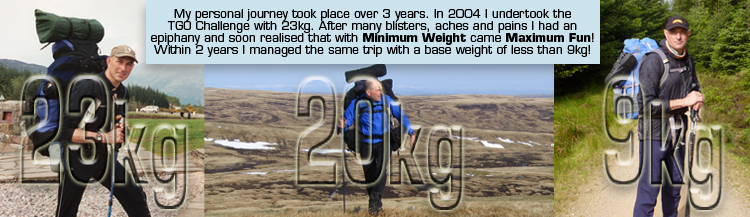
Prior to my ‘personal’ lightweight journey, for a particular regular trip in the UK my pack always weighed 21kg. Every year, on the same trip it has reduced in proportion to the increase in my knowledge, and I can now do the same trip well under 10kg, without any blisters, exhaustion or misery. Maximum pleasure!
Footnote: We also undertake over night adventure racing which requires you to carry all you need on a minimal basis. Our packs weight less than 4kg using the same approach and same equipment, just less of it.
I only know of one person in the UK who meets the Super-Ultralite category and he is prepared to travel much further off the path of comfort than we are.
He travels to the limit of his equipment’s ability and is in no danger, as he knows fully what these are. If you are ever unsure, step back and review the situation or equipment. True lightweight knowledge and experience takes time to gather, but once learned is never forgotten. Your body will thank you in later years.
|
|
|
